Loading article…
← Journal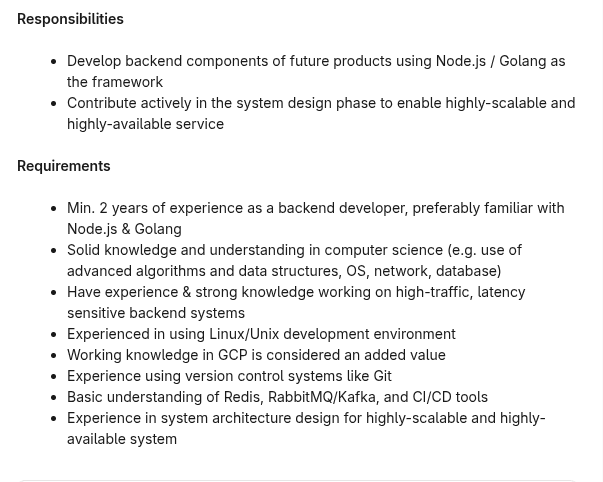
•11 min read
Why You Don't Need a Bootcamp to Become a Programmer
Do you really need a bootcamp to become a programmer? What about IT college? Should you go to college or join a bootcamp?
Programming
Bootcamp
Rant
Software Development
Campuss Life
Ads and Dreams
"Learn coding in 3 months and get a job as a software developer!"
— literally every ad ever.
In the last 2 years, or even 3 years, I've often seen bootcamp ads everywhere like Data Analyst Bootcamp, Full-stack Developer Bootcamp, Web3 Developer Bootcamp, you name it. And every time you see their ad, it looks very promising and the testimonials are bombastic, haha; Their alumni work at big companies, and so on.
There are some similarities regarding what they usually sell or write in their ads, namely:
- Promise of two-digit salary (sometimes over 20 million, even though the minimum wage might not even pass that, haha).
- Promise of remote work, flexible, work-life balance.
- Promise to start from zero, even if you "don't understand computers at all."
But the question is: is the reality really like that?
Many People Are Successful Working Remote
Yes, of course there are. But what you're seeing is just the highlight reel. What you don't see are those who failed, got burned out, or were confused because after graduating from bootcamp, they felt they couldn't do anything. After all, it's called marketing, right? What bootcamp would honestly advertise:
"From 50 participants, only 5 finally got permanent jobs"? 😭
Personal Experience
I've been to a bootcamp myself, and during my time at bootcamp there were about 11-12 other people who joined bootcamp there too. These 11-12 people were people who had previously learned there and became mentors or people who just signed up and became batch mates. The background of people signing up also varied, some from IT majors, some already working, working in IT too (but already a boomer), or starting from 0. In short, from those 11-12 people, those who finally worked in accordance with what was advertised by the bootcamp was only 3-4 people, 2 programming 2 design (if I remember correctly, bro). And interestingly, the two in programming were not the ones starting from zero.
This means that those who really succeeded weren't just because of the bootcamp alone, but because they already had a foundation or direction themselves. The bootcamp was just a tool, not a magic door.
So, Is Bootcamp Bad?
Not really. Bootcamp isn't evil, but it's also not a miracle cure. It can be a fast track if you know where you're going, but it will be a dead end if you're just following trends. The problem is, many people enter bootcamps with high hopes, but come out confused, because it turns out learning coding isn't about "taking classes", it's about a long process and consistency. It's still a common thing about the mindset of achieving something instantly, especially in Indonesia, this kind of mindset must be changed, there's no fast way to get something except gambling, haha.
As long as this kind of mindset still exists, don't be surprised if many people eventually feel "cheated" after joining a bootcamp and not getting the expected results.
Something you get instantly,
will disappear instantly too.
But it's not just about mindset, there's something even scarier, which is when you try to sign up for a bootcamp, but you don't get what the bootcamp advertised. If it's like this, then the bootcamp itself is problematic. So, besides expectations that need to be managed, we also need to be smart in choosing a bootcamp or place to learn that's truly good.
So, Is It Better to Go to College?
I've also asked the same question, is it better to go to college or bootcamp?, Is college better than bootcamp? Interestingly, the answer is not always 'Yes'.
But, college is a safer choice if you:
- Only have a high school diploma,
- Not yet married / don't have big responsibilities (not sandwich generation),
- Unemployed and still young,
- Have money to go to college,
then college can be a safer and more stable option.
Because college gives you time to explore more broadly, not just "learning coding," but also how to think, public speaking, teamwork, connections, and other things that might not be what you get in bootcamp.
Everything About Bootcamp and College
After yapping at length about bootcamp and college, let's try to compare them in general and provide tips related to bootcamp or college so you have an idea and be more realistic in viewing these 2 things.
Disclaimer: These tips are based on personal experience, they may be wrong or less relevant. So take what's suitable, skip the rest, it's okay.
Bootcamp (Programming)
Before rushing into a bootcamp, I suggest utilizing the free tutorials available, there are so many on Youtube, ranging from basic to advanced. If you need something more, you can utilize joining membership on a channel that you think is good and affordable, I think it's more worth it compared to the prices of bootcamps that exist today.
Make your hands dirty, Coding isn't just watching video tutorials then hoping to suddenly be good at it, but requires practice to get used to using the syntax, debugging, and problem solving. If you just watch and hope to be good it's the same as liking someone. But instead of trying to get close, you just hope they realize on their own that you like them. (they won't realize, bro 😭).
I suggest learning using a Project-Based Learning approach. Set an initial goal why you chose to learn that, choose projects that are easy and realistic first. Especially with the existence of AI, if you're good at utilizing it, it should be able to make you 10x more effective and productive compared to without AI. No need to be embarrassed to code using AI, everyone is doing it now anyway, what's important is understanding the concept and how it works. Make sure you really understand, not just 'Copas from the result of AI generation'. (Aiihh)
At this point, many people will get stuck in two things: tutorial hell (watching continuously without practice) or impostor syndrome (feeling not good enough even though you can). And believe me, this is very normal. Everyone has been through that phase. So how to get out? Try opening platforms like LinkedIn, Jobstreet, or Upwork. Find the position you want, read the requirements. If you feel you match about 70–80%, that means you're already ready enough to apply for jobs. Don't wait until "perfect", because those who are perfect won't start.
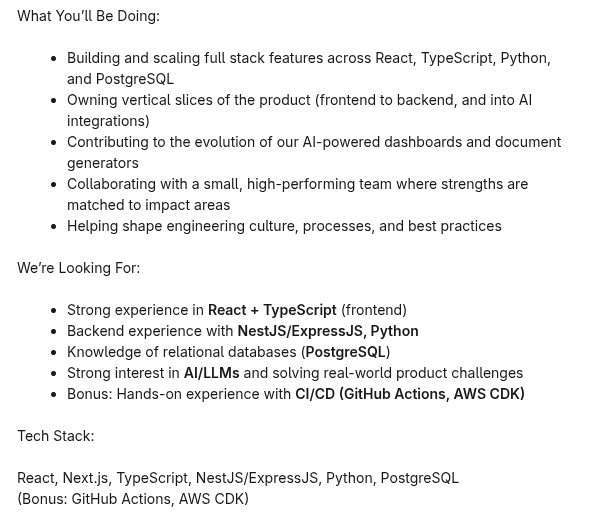
Example: Let's say the skill set you have is React/NextJs, Express, Typescript, Python, Docker, Redis, PosgreSQL and AWS. Say your skills related to Redis and AWS are at a basic level, and this is the job post you found online.
Well, from the vacancies above, with your current skills you should already be able to send applications for those vacancies. You don't need to be super good at Go, RabbitMQ, Kafka, NestJs, etc.
If you still feel not confident and are having trouble getting a job, here I think is the right time for you to sign up for a bootcamp. But, about ways or tips to get a remote job maybe we'll discuss in another article.
I suggest understanding 1 frontend framework, 1 backend framework, 1 SQL & No-SQL Database, Docker, 1 Cloud (AWS, GCP, Azure, DigitalOcean, etc.) No need to be super good, at least you've tried services that are often used e.g EC2 (AWS), S3 (AWS), Lambda (AWS), etc.
College (Computer Science / Informatics)
Now let's talk about college.
In majors like Informatics or Computer Science, you'll meet things like:
- Algorithms & Data Structures (so you're good at leetcode and hackerrank),
- Operating Systems,
- Computer Networks,
- Databases,
- up to Language Theory & Automata (which often makes people think, "what kind of course is this?, looks useless.")
Indeed, sometimes there's too much theory, and lecturers like to give weird assignments (trust me, I've been there). But this part is important, because it makes you understand the foundation of all the modern frameworks and tools you'll use later.
Frameworks can change, programming languages can change, but basic concepts won't change.
Another advantage of college, you have time to explore and fail. You can join organizations, competitions, research, or lecturer projects, all of which can be stepping stones for your career later. And the most underrated: networking. Your college friends now can become CTOs, co-founders, or HR people who will accept your application later.
But yes, college is also not the most efficient ninja track if you just want to work quickly. Four years is a long time, and not all campuses teach things relevant to industry. I've worked before entering college, and I felt how big the gap is between industry needs and what is taught on campus. Well, internship or PKL can be a middle ground to overcome that gap, so make sure to take internship opportunities as much as possible. If possible, intern abroad too.
If you already have a clear and strong direction in the field of programming, sometimes not going to college you can still survive, as long as you truly learn and have a portfolio. In my opinion, it's better to learn coding before entering college. From my own experience, the first 4 semesters there's nothing new from what I learned self-taught (it feels like a waste of money to pay for college, damn). With you being able to code, 90% of your time on campus is idle, so you can utilize it while joining competitions, internships, and exploration.
If your college is offline (face-to-face), I suggest don't be shy to offer yourself to lecturers, you'll definitely be asked to help for free, but remember first, what you're building is a legacy. Get experience first that's a lot, increase your value first. Also don't be arrogant, because there are still many people who are 10x better than you.
Conclusion: Do You Need Bootcamp or College to Become a Programmer?
The honest answer is: there's no single path to becoming a programmer. Bootcamp, college, or self-learning are all just tools. What determines the final result is still you yourself.
If you're the type who needs structure, encouragement, and learns quickly through practice, bootcamp can be suitable as long as you research first and know your expectations. But if you want a strong foundation, want to understand concepts, and still have time + resources, college can be a more stable choice for the long term.
But outside of all that, the most important isn't where you learn, but how you learn.
Coding isn't about following trends, but about curiosity, consistency, resilience and adaptability. Technology changes very quickly. What keeps you relevant isn't because you're "smart", but because you never stop learning.
Bootcamp can help you start. College can help you understand. But what makes you survive in the IT world is the ability to keep adapting and improving.
Free Resources for Learning Programming
If you're starting from zero and want to learn with very minimal cost, here are some resources that are truly worth it and you can explore right now:
-
CS50 – Harvard University The most popular free course for beginners. Teaches basic Computer Science from scratch, even more complete than what is taught on campus (mine), haha.
-
The Odin Project Learn full-stack web development for free. Project-based and complete from HTML, Node.js to Ruby.
-
freeCodeCamp Interactive platform for learning coding directly in the browser, plus free certification. Their Youtube is also very complete, the videos can be hours to days long.
-
roadmap.sh Visual learning map showing what skills sequence you need to master for each role (frontend, backend, devops, etc.).
In conclusion, you don't need a bootcamp or college to become a programmer. You just need a curiosity that never fades away. — wer rastet der rostet